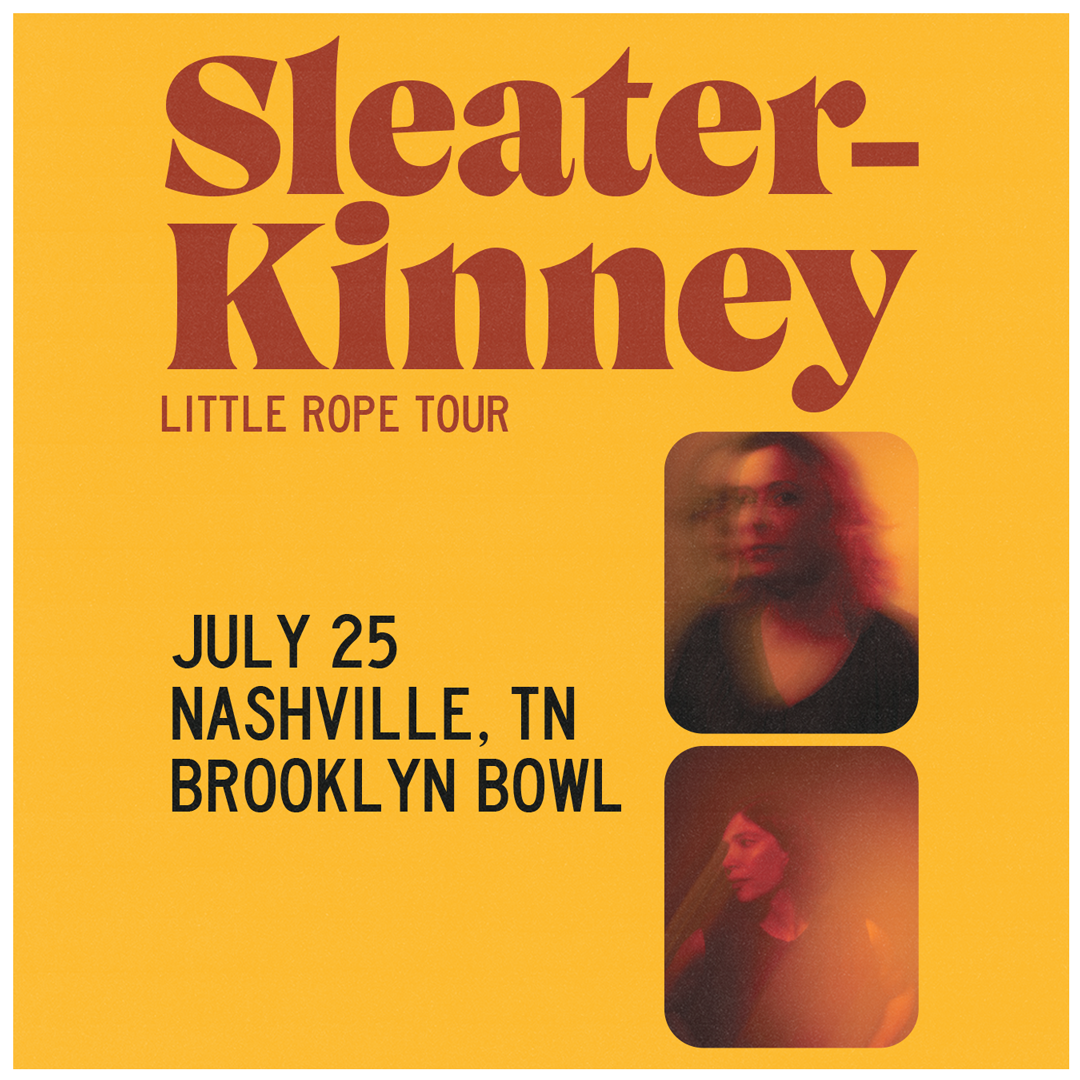
Sleater-Kinney
Die Spitz
Event Info
Brooklyn Bowl Nashville
925 3rd Avenue North
Nashville, Tennessee 37201
This ticket is valid for standing room only, general admission. ADA accommodations are available day of show. All support acts are subject to change without notice. Any change in showtimes or other important information will be relayed to ticket-buyers via email. ALL SALES ARE FINAL Tickets purchased in person, subject to $3.00 processing charge (in addition to cc fee, if applicable). Sales Tax Included *Advertised times are for show times - check Brooklyn Bowl Nashville website for most up-to-date hours of operation*
Artist Info
Sleater-Kinney
Sleater-Kinney has announced their eleventh studio album, Little Rope, which will be released January 19, 2024 via Loma Vista Recordings with a hauntingly intimate music video for lead single “Hell”, directed by Ashley Connor and starring Miranda July. Recorded at Flora Recording and Playback in Portland, Oregon with Grammy-winning producer John Congleton, Little Rope is a powerfully honest and soul-baring album by one of modern rock’s most vital bands.
Little Rope is one of the finest, most delicately layered records in Sleater-Kinney’s nearly 30-year career. To call the album flawless feels like an insult to its intent – it careens headfirst into flaw and brokenness – a meditation on what living in a world of perpetual crisis has done to us, and what we do to the world in return. On the surface, the album’s 10 songs veer from spare to anthemic, catchy to deliberately hard-turning. But beneath that are perhaps the most complex and subtle arrangements of any Sleater-Kinney record, and a lyrical and emotional compass pointed firmly in the direction of something both liberating and terrifying: the sense that the only way to gain control is to let it go.
In the autumn of 2022, Carrie Brownstein received a call from Corin Tucker, who herself had just received a call from the American embassy in Italy. Years earlier, Brownstein listed Tucker as her emergency contact on a passport form, and while she had since changed her phone number, Tucker had not. The embassy staff were desperately trying to reach Brownstein. When they finally did, they told her what happened: While vacationing in Italy, Brownstein’s mother and stepfather had been in a car accident. Both were killed.
Although some of the album had already been written, aspects of each song—a guitar solo, the singing style, the sonic approach—were pulled into a changed emotional landscape. As Brownstein and Tucker moved through the early aftermath of the tragedy, elements of what was to become the emotional backbone of Little Rope began to form – how we navigate grief, who we navigate it with, and the ways it transforms us. The result is a collision of certainty and uncertainty evident from the first few spare seconds of the record’s opening track and first single, “Hell.” Over an agoraphobic expanse of tone and a trickle of chords, Little Rope’s emotional thesis statement begins to take form:
Hell don’t have no worries
Hell don’t have no past
Hell is just a signpost when you take a certain path
It’s a restrained, controlled prologue, but control is fleeting. A few seconds later, well, all hell breaks loose.
Die Spitz
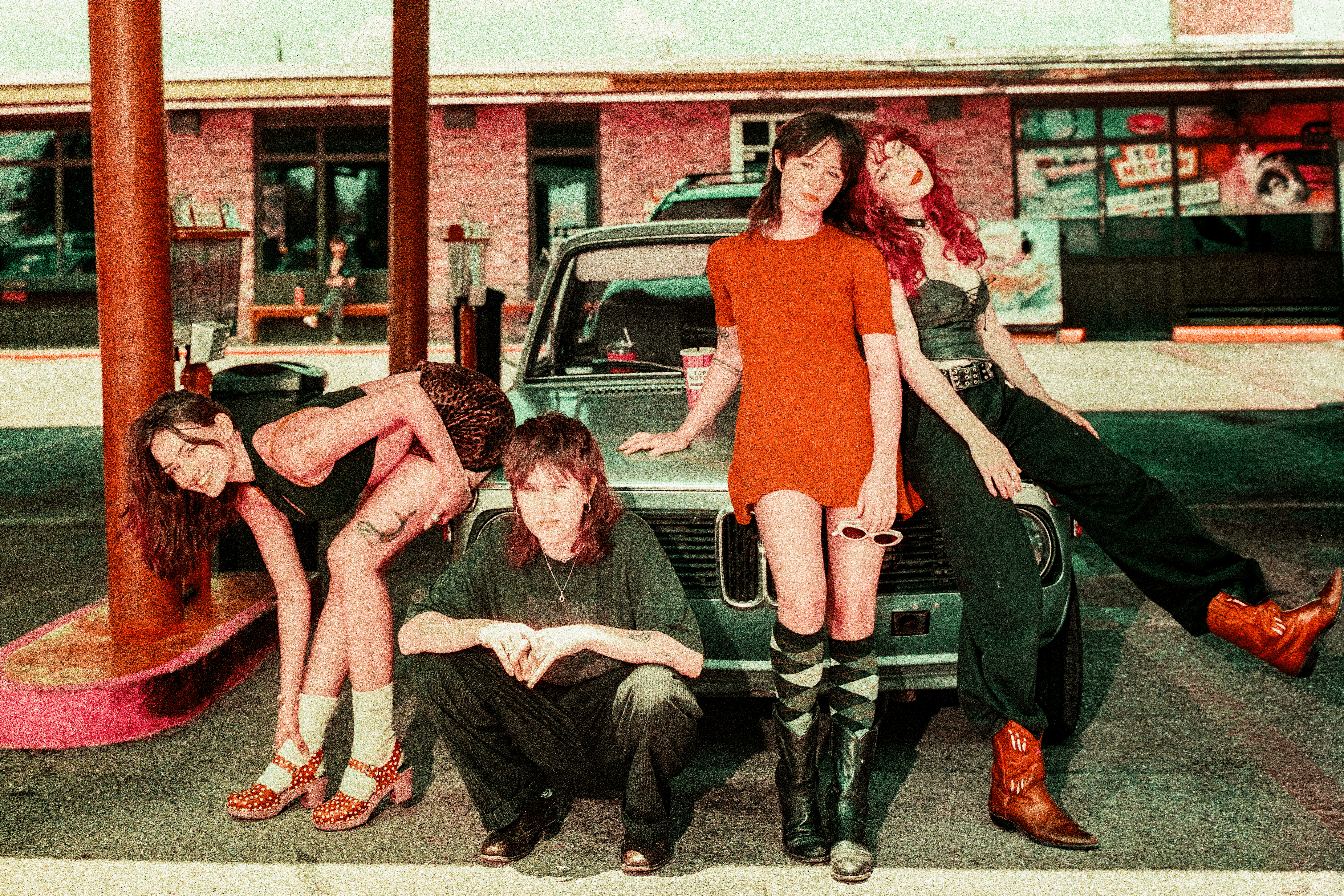
When the Venn diagram of passion, friendship, identity, and artistry collide, it can feel as if fighting words are spitting from your veins. And as postmodern society crumbles, Die Spitz giddily bounce between a dozen different ways to push back. If the world of rock music were an ice cream shop, the Austin quartet have sampled each flavor, flipped the freezer over, and started dancing with the employees they helped unionize. On their debut album, Something to Consume (due Sept 12 via Third Man Records), Ava Schrobilgen, Chloe De St. Aubin, Eleanor Livingston, and Kate Halter fight against the inescapable consumption that surrounds life. “There’s a political side to it, but addiction and love can also be all-consuming,” Livingston says. And as the foursome trade off instruments, swapping songwriting and vocal duties, and generating powerful songwriting in concussive bursts, Die Spitz have created their own little pocket of the world where we can all stand on the edge together. That unity comes in part from the deep bonds between the 22-year-olds. All four are Austin natives, with Schrobilgen and Livingston having met in preschool, befriending Halter in middle school, and immediately bringing De St. Aubin into their inner circle when they formed the band in 2022. Though they’ve only been playing together a few years (not to mention Halter only learning to play bass to start the band), Something to Consume shows a maturity and technical prowess always wielded in service of their profound friendship. The group settled on the name Die Spitz over a “brown bag of Fireball”, opting for the feminine German definite article in place of the English. “It reminds me of the Grim Reaper spitting,” Livingston jokes. At their first live shows, they paired originals with covers from some of their inspirations: Black Sabbath, Pixies, Mudhoney, PJ Harvey, and Nirvana. The beguiling "Pop Punk Anthem" somehow encapsulates elements throughout that large musical swath, building from roiling verses to a growled chorus. “It may sound like a love song at first, but when the beat kicks in it’s the obsession that takes over,” Schrobilgen says. “The words ‘you’re a part of me’ sound loving but it can be an insane emotion and privilege over someone else’s life.” As if their closeness as a band weren’t enough, the members of Die Spitz have also intermittently been roommates and still live near each other. “We call it sitcom life,” Livingston laughs. That said, the Die Spitz TV show would have a significantly different soundtrack to your usual sitcom fare. The Austinites express their ideas through a blend of classic punk, hardcore, metal, alt rock and more. The group have become known for their riotous live shows, where dueling cartwheels, Halter playing bass mid-crowdsurf, Schrobilgen unleashing a growling bark, and Livingston posing with the microphone on top of the venue’s bar or climbing into the rafters could happen at any moment. Pairing their mind-melting gigs with even more impressive songs has led to stints opening for (and rivaling the energy of) bands like OFF!, Amyl and the Sniffers, Viagra Boys, and Sleater-Kinney. That shapeshifting strength comes into full view on the explosive “Throw Yourself to the Sword”, a song that raises a righteous fist of empowerment over thrash guitar. “Throw yourself/ To the sword,” the start-stop chorus begins, before taking a more modern turn. “What’s it like knowing/ None of you bitches can compete?” Livingston sees the song as an important reminder to let go of insecurities and embrace the power you have over yourself—something that unifies the Die Spitz catalog. “Be the bad bitch you are amongst the mundane and use your voice as a young person,” she says. “Don’t let these old fools tell you you can’t do anything.” Whether on the punk chug of "RIDING WITH MY GIRLS" or the syrupy grunge of "Go Get Dressed", Something to Consume moves with rapturous conviction thanks in part to the deft production hand of Studio 4’s Will Yip. Though only recently in their 20s, Die Spitz’s impressive musicianship ties them clearly to a long lineage of frustrated people hoping to inspire change. “Some people aren’t interested in being political activists via music, but it weighs on me heavily and I feel misaligned with my calling if I don’t,” De St. Aubin says. “The four of us are free spirits with multiple interests, and there’s no limit or power dynamic that can derail us.” The thrumming “Voir Dire” embodies that expressive strength, an acoustic-driven jam that airs frustrations with American globalism. “Unless we’re part of the few in power, we’ll someday be victimized and regret that we didn’t act now,” De St. Aubin adds. “America brings war on marginalized people in our own country and other lands, and being complacent will not be comfortable forever.” Elsewhere, the grimy and pained “Punishers” explores the frustration and ache of a relationship that just won’t work despite best intentions—two people punishing each other instead of just letting go. But even when they’re tackling these sort of impactful themes, Die Spitz infuse the proceedings with a golden warmth. These aren’t songs of vicious mockery, but charged rallying calls—which in turn ties back to the band’s origin story. “It was a joke that went too far,” Halter smirks. “We never thought it was going to be a real thing.” Across 11 tracks, Something to Consume contains multitudes and yet feels of a singular piece, an expansive and expressive set unified in its camaraderie and freedom. “We depend on our freedom—freedom to do what we want, present the ideas we want, make the music we want,” Livingston says. “Whether it’s based in metal or something soft, no matter which of us wrote the song, we all contribute and work together. As a person, I don’t have a strong ego or voice, but within this band each one of us is capable of so much more.”
Just Announced


Up Top Comedy
Mookie G, Allison Flowers, Andrew McAffry, Ross Richard



Valley - Do You Need To Be Entertained? The Tour
Moody Joody